Recommended Tire Pressure vs. Maximum Tire Pressure: What's the Difference?

Share
This guide is based on U.S. federal vehicle and tire regulations (FMVSS, enforced by NHTSA). Vehicles registered outside the United States may use different labeling requirements and warning thresholds; check your vehicle's owner's manual or local regulator for those figures.
The short answer
In the United States, passenger vehicles are required to carry two distinct PSI numbers, and they are not interchangeable.
The vehicle manufacturer's recommended tire pressure is printed on a placard inside the driver's door jamb, or in the glove box on some older vehicles. This is the cold inflation pressure the vehicle was engineered around, for that specific tire size, on that specific vehicle.
The maximum tire pressure is molded into the tire's sidewall, next to wording such as "MAX PRESS" or "MAX. PRESS. COLD." This number comes from the tire manufacturer, not the vehicle manufacturer, and it describes a structural ceiling, not a recommended operating pressure.
When the two numbers differ, use the placard number for normal driving. A tire built with a higher maximum pressure than the vehicle calls for is still supposed to run at the vehicle's lower recommended figure, because the vehicle's suspension, handling, braking, and load ratings were calculated around that number, not the tire's structural ceiling.
Where to find the vehicle manufacturer's recommended pressure
Under U.S. federal regulation FMVSS No. 110, vehicle manufacturers must place a Tire and Loading Information placard on the vehicle. For vehicles manufactured on or after September 1, 2005, this placard (or a placard paired with a supplementary tire inflation pressure label) is located on the driver's side door edge or B-pillar, the door jamb visible when the door is open. Earlier requirements allowed the label on the glove compartment door or another equally accessible location, which is why some older vehicles have it there instead.
The placard lists:
- The recommended cold tire inflation pressure for the front and rear tires
- The recommended tire size for the vehicle
- The vehicle's total occupant and cargo weight capacity
The same recommended pressure also appears in the owner's manual, in the section covering tires or maintenance specifications. If the two ever seem to disagree because of a tire size change, the manual and any manufacturer-issued update take priority.
What the recommended PSI actually means
The recommended pressure is not a generic estimate. It reflects the vehicle manufacturer's engineering calculations for that specific combination of vehicle weight, suspension design, tire size, and intended ride and handling characteristics.
This number is defined as a cold pressure, meaning it assumes the tire has not been driven on recently and is close to outside ambient temperature.
Because this number is vehicle-specific, it does not transfer between vehicles, even similar ones. A recommended PSI for one sedan model is not a safe assumption for a different sedan, SUV, or truck.
What the tire sidewall's maximum pressure means
The number molded into the sidewall, labeled with wording such as "Max. Press." or "Max Press Cold," comes from the tire manufacturer, not the vehicle manufacturer. It represents the highest cold inflation pressure the tire is built to hold at its maximum rated load, under federal tire construction standards (FMVSS No. 139, which covers radial tires on modern light vehicles).
This number exists so the tire is not overloaded or overinflated beyond its structural design, independent of which vehicle it is eventually mounted on. The same tire model and size can be sold for use across more than one type of vehicle, so its maximum pressure is set independently of any single vehicle's handling calibration.
Why the sidewall maximum is not the normal inflation target
The sidewall maximum answers "how much pressure can this tire structurally hold," not "what pressure should this vehicle run." Those are different engineering questions with different answers.
Inflating to the sidewall maximum on a vehicle whose placard calls for a lower number changes the tire's contact patch, ride quality, and handling behavior away from what the vehicle manufacturer calibrated for. Reaching a higher pressure does not, by itself, make the tire safer, and it is not the pressure the vehicle's braking, traction, and stability systems were tuned for.
A documented exception exists under federal regulation for specific manufacturer-specified loading conditions, where a manufacturer may list an alternative pressure on the placard for a condition such as maximum cargo load. Outside a documented, manufacturer-specified condition like that, the sidewall number is not a substitute for the placard number.
What "cold tire pressure" means
"Cold" does not refer to outside temperature. It refers to the tire's condition: a cold tire is one that has not been driven on recently and has had time to return to ambient temperature.
Driving heats the air inside a tire through friction and flexing, which raises the pressure reading. Checking pressure right after highway driving, or after a tire has been sitting in direct sun, produces a higher number than the tire's true cold pressure, even if no air was added. This is why the placard figure and any manufacturer guidance are defined as a cold measurement.
Do front and rear tires need different pressure?
On some vehicles, yes. The placard may list a different recommended PSI for the front axle than the rear axle, reflecting differences in weight distribution, drivetrain layout, and how the manufacturer tuned handling for that platform.
Not every vehicle uses different front and rear numbers; some list a single pressure for all four positions. The placard is the only reliable way to know which applies to your vehicle.
How vehicle load can affect the recommended pressure
FMVSS No. 110 allows manufacturers to list more than one recommended pressure on the placard when a vehicle has more than one manufacturer-specified loading condition, for example a standard load condition alongside a maximum-load or towing condition. When a placard includes more than one figure, it also states which loading condition each pressure applies to.
If your placard lists only a single pressure, that figure is the applicable number under standard load conditions.
Replacing tires doesn't change your recommended pressure on its own
If you replace your original tires with a different tire, even one rated for a higher maximum pressure, your vehicle's placard pressure does not change by itself. The placard reflects the vehicle manufacturer's calibration, not the specific tire installed at any given time.
An exception can apply when a replacement tire's size or load range differs from the original equipment tire. Confirm this directly with the installing tire retailer or the vehicle manufacturer rather than working it out on your own.
What to do if the door-jamb placard is missing or unreadable
If the placard is missing, faded, or was removed during a repair, do not default to the tire sidewall number. Instead:
- Check the owner's manual, which lists the same recommended pressure figures.
- Contact the vehicle manufacturer or a dealership service department, which can look up the original specification by VIN.
- Ask a tire retailer to look up the manufacturer-specified pressure for your exact vehicle and trim.
Do not estimate a replacement number, and do not treat a pressure printed on packaging, a prior owner's note, or a general reference chart as a confirmed substitute without verifying it applies to your specific vehicle and tire size.
How recent driving and temperature can affect a pressure reading
Because recommended pressure is defined as a cold measurement, two situations can distort a reading:
Recent driving. A tire that has been driven on will read higher than its true cold pressure, because heat raises pressure. The accurate approach is to check before driving rather than estimate how much heat has inflated a reading.
Temperature swings. Tire pressure changes with ambient temperature even without driving. Tire manufacturers, including Goodyear and Firestone, describe an approximate change of about 1 PSI for every 10°F change in outside temperature as a rule of thumb, not a precise formula. A significant overnight temperature drop can lower a tire's pressure enough to trigger a dashboard warning without any air having leaked out.
How TPMS relates to the recommended pressure
A Tire Pressure Monitoring System (TPMS) does not measure against the tire's sidewall maximum. Under federal requirements (FMVSS No. 138), TPMS is designed to warn the driver when a tire's pressure falls to approximately 25 percent below the vehicle manufacturer's recommended placard pressure, or a minimum activation pressure specified in the standard, whichever is higher.
This ties the warning light to your vehicle's specific recommended pressure, not to the tire's molded maximum. A TPMS warning is a signal to check pressure against your placard number; it does not by itself say exactly how much air to add or, on some systems, which tire triggered it.
Before adding air: when to stop instead of inflating
Adding air is appropriate for ordinary low pressure. It is not appropriate if the tire or wheel shows any of the following:
- Cuts, bulges, or exposed cord on the sidewall or tread
- Shoulder damage or signs of separating tread
- A visibly bent, cracked, or damaged wheel
- Signs the tire has separated from the wheel bead
- Visible damage to the valve stem
- The tire has been driven while flat or significantly underinflated
- Pressure that will not build, or will not hold, during a fill attempt
- Unusual vibration, pulling, noise, or handling from the vehicle
- An unsafe roadside location for stopping to inspect or add air
If any of these apply, stop adding air and do not continue driving on that tire. Use a spare tire if your vehicle is equipped with one and the situation fits your owner's manual's restrictions, or contact roadside assistance.
Using a portable inflator without exceeding the correct target
A portable tire inflator is a tool for reaching a specific pressure, not for reaching the tire's maximum capability. The target should be the vehicle's placard pressure, or the manufacturer-specified figure for a documented load condition that applies to your situation, not the number on the tire sidewall.
General steps when restoring pressure with a portable inflator:
- Before connecting anything, confirm none of the stop conditions above apply, and confirm the correct target pressure from the placard or owner's manual.
- Check pressure when the tire has not been driven on recently, for a reading closer to true cold pressure.
- Connect the inflator's air hose securely to the tire valve.
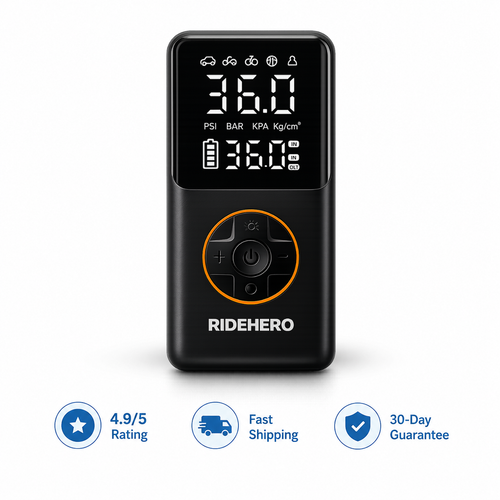
- Set the target to the placard figure, not the sidewall maximum. RideHero Air stops automatically once the preset pressure is reached, accurate to within ±1 PSI.
- Recheck the reading on the inflator's display regardless of whether the unit stopped on its own, and stop adding air once the target is confirmed.
Reaching the correct placard pressure restores normal inflation. It does not, by itself, confirm that a tire is free of hidden damage, sidewall cracking, an embedded object, or a slow leak, and it does not override any of the stop conditions above.
When repeated pressure loss means it's time for inspection, not just more air
Adding air resolves a pressure gap; it does not diagnose why the gap happened. If a tire needs air again within a short timeframe after being filled to the correct pressure, that pattern points to a possible slow leak, valve stem issue, puncture, or wheel-seal problem that inflation alone will not fix.
A single low-pressure reading, especially one that follows a known temperature swing, is not the same signal as a tire that keeps losing pressure across repeated checks. Repeated loss is a reason to have the tire inspected by a qualified technician.
Common mistakes worth avoiding
- Inflating to the sidewall maximum because it's the larger, more visible number
- Assuming all four tires use the same pressure without checking the placard
- Checking pressure right after driving and treating that reading as the true cold pressure
- Assuming a placard number still applies after a tire size or load range change, without confirming it
- Treating a single low-pressure event the same as a recurring leak
- Adding air to a tire with visible damage or abnormal handling instead of treating it as a stop condition
Where the RideHero portable tire inflator fits
A portable inflator, such as the RideHero Portable Tire Inflator, is useful for restoring pressure to the correct target once you know that target, whether that's before a drive, after a TPMS warning, or as part of routine maintenance. Its digital display and preset-pressure function are designed to reach a specific number rather than run until the tire feels firm — accurate to within ±1 PSI, with an automatic shutoff once your target is reached.
The inflator cannot tell you what your vehicle's recommended pressure is, and it cannot diagnose why a tire lost pressure in the first place. Those answers come from your placard, owner's manual, or a qualified technician.
Recap: placard vs. sidewall
- Use the door-jamb placard number for daily driving, not the tire sidewall number.
- The sidewall number is a structural maximum, not a target.
- Recommended pressure is a cold measurement; check before driving when possible.
- Front and rear pressures may differ; the placard shows this if it applies to your vehicle.
- Replacing tires does not change your recommended pressure on its own.
- A missing placard should be replaced with information from the owner's manual or manufacturer, not the sidewall number.
- TPMS warnings are calibrated to your vehicle's recommended pressure, not the tire's maximum.
- Visible tire damage, pressure that won't hold, or abnormal handling are stop conditions, not low-pressure events.
FAQ
Is it ever correct to inflate to the number on the tire sidewall?
Only when the vehicle manufacturer specifically lists that figure for a documented loading condition on the placard or in the owner's manual. Otherwise, the sidewall number is a maximum, not a target.
Why would a tire have a higher maximum pressure than my vehicle recommends?
Tire manufacturers rate a tire's maximum pressure independently of any one vehicle, since the same tire size can be used across different vehicle types. Your vehicle's placard pressure reflects your specific vehicle's engineering, which can be lower than what the tire itself can structurally hold.
Does a new set of tires change my recommended pressure?
Not on its own. The placard reflects the vehicle manufacturer's specification. A pressure change is only appropriate if the replacement tire's size or load range differs from the original.
What if my door placard is missing?
Check the owner's manual first. If that's unavailable, a dealership service department or tire retailer can look up the manufacturer-specified pressure using your vehicle's VIN.
Does the TPMS light tell me exactly how much air to add?
It indicates that at least one tire has fallen to approximately 25 percent below your vehicle's recommended pressure, or a minimum threshold set by federal standard, whichever is higher. It does not replace checking the exact pressure with a gauge.
Can a portable inflator overinflate my tire past the correct pressure?
It can, if the target isn't set correctly or the operator keeps adding air past the intended pressure. Setting the target to your vehicle's placard pressure, not the sidewall maximum, reduces this risk.
The bottom line
The number that matters for daily driving is the one on your door jamb, not the one on your tire. When you're ready to check or restore pressure, a portable inflator with a digital display and preset-pressure function, such as the RideHero Portable Tire Inflator, can make it easier to reach that exact number instead of estimating by feel. It's a tool for reaching a pressure you've already confirmed, not a substitute for knowing what that pressure is, checking the tire for visible damage first, or having a tire inspected if it keeps losing air.